
If you are thinking about becoming a pilot, the timing could not be better. The global aviation industry is experiencing in 2026 one of the highest-demand periods for pilots in its history, and projections indicate this trend will not reverse in the next two decades.
In this article we analyze why pilot demand continues to grow, which regions lead that demand, what salaries look like, and what all of this means for someone considering training at an FAA-certified school like ADF FLIGHT SCHOOL.
The global pilot shortage: a structural problem
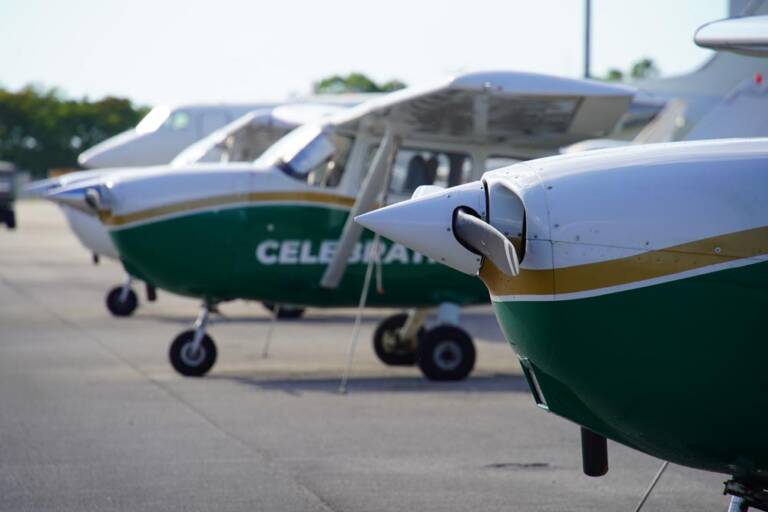
The 2020 pandemic accelerated the early retirement of thousands of experienced pilots worldwide. When flight demand recovered, the industry found an enormous gap between available pilots and what it needed to operate normally.
But the shortage is not only a pandemic consequence. It is a structural problem decades in the making: airlines grow faster than flight schools can train new pilots, active pilots retire at a steady rate, and new routes in emerging markets demand more crews.
New pilots North America will need over the next 20 years
According to Boeing, North America will require more than 170,000 new pilots by 2043 just to sustain current operations and absorb projected growth.
New pilots the world will need over the next 20 years
Boeing’s global demand projection exceeds 649,000 new pilots by 2043. Asia-Pacific, the Middle East, and Latin America lead the growth.
Years: mandatory retirement age for commercial pilots in the U.S.
The mandatory retirement rule at 65 guarantees a constant outflow of experienced pilots from the market, creating vacancies that must be filled by new generations.
Where is demand growing the most?
The pilot shortage is not uniform: there are regions where pressure is especially intense and where opportunities for FAA-licensed pilots are particularly attractive.
| Region | Why demand is growing |
|---|---|
| North America | U.S. regional airlines are hit hardest by the shortage. The 1,500-hour rule for commercial airline pilots (ATP) has created fierce competition for qualified pilots. Entry-level salaries have risen significantly over the last three years. |
| Latin America | Tourism growth and an expanding middle class in Colombia, Mexico, Brazil, and Peru have driven regional airline expansion. Many of these markets seek pilots with FAA training for international routes. |
| Asia-Pacific | China, India, and Southeast Asia represent the world’s fastest-growing aviation market. Demand is so high that many Asian airlines actively recruit at U.S. and European flight schools. |
| Middle East | Gulf airlines (Emirates, Qatar Airways, Etihad) continue expanding their fleets and routes, offering highly competitive packages for pilots with international certifications. |
| Europe | Post-pandemic recovery in Europe was slower, but the low-cost sector continues growing and generating steady demand for first officers with verifiable flight hours. |
What do salaries look like in 2026?
One of the most tangible changes from the pilot shortage is the impact on salaries. Airlines have had to improve compensation packages to attract and retain talent in an increasingly competitive market.
U.S. regional airlines
Regional airlines, which historically paid low entry salaries, have significantly raised their offers. First officers can now expect starting salaries that were once exclusive to major carriers, plus signing bonuses, student loan repayment programs, and accelerated paths to captain.
Major carriers (legacy airlines)
Captains at airlines like Delta, American, or United reach salaries placing them among the highest-paid professionals in the country. The shortage has accelerated the timeline from first officer to captain at several of these carriers.
Corporate and charter aviation
Corporate and charter aviation offers very attractive conditions: more predictable schedules, modern aircraft, and in many cases salaries competitive with regional airlines. It is a path many pilots choose for quality of life.
The effect of the shortage on career timelines
Under normal market conditions, a pilot could take 8 to 10 years to advance from flight instructor to airline captain. The current shortage has compressed that timeline significantly at many U.S. regional airlines, where some pilots are reaching captain in 3 to 5 years from the start of their commercial career.
The role of the FAA license in the global market
One of the most strategic decisions a pilot in training can make is which certification system to train under. The FAA license has concrete advantages in the global job market:
- International recognition: The FAA license is recognized or can be converted in many countries around the world through relatively straightforward processes.
- Reference standard: Many airlines outside the U.S. use FAA standards as a reference for evaluating pilots, even when operating under other regulations.
- Access to the U.S. market: With an FAA license you can legally work as a pilot in the world’s largest and most active aviation market.
- Training in complex airspace: Training in the U.S., especially in markets like Miami, exposes the pilot to real air traffic and communication procedures that are a global reference.
2026 is a good year to start
At ADF FLIGHT SCHOOL, a flight school with more than 40 years of history and over 8,000 pilots graduated, we see every day how the job market validates our students’ decision. Many of our recent graduates have entered the market under conditions that ten years ago would have seemed out of reach: signing bonuses, shorter advancement timelines, and a demand that gives them negotiating power from day one.
If you are considering starting your training, the 2026 market context is one of the strongest arguments in your favor. Explore our available programs or speak with an advisor to understand how your profile fits into this market.
Frequently asked questions about the 2026 pilot job market
Is pilot demand real or just flight school marketing?
It is real and documented by independent sources. Boeing publishes its annual Pilot & Technician Outlook based on aircraft orders, route growth, and retirements. IATA and the FAA also publish analyses confirming the trend. This is a structural consequence of industry growth and the aging of the current workforce.
How long does it take a pilot to work at an airline starting from scratch?
The standard path in the U.S. runs from Private Pilot Certificate through ATP, passing through Instrument Rating, Commercial Certificate, and CFI. Many pilots complete the path in 3 to 5 years from the start, depending on training intensity.
Do Latin American airlines hire pilots with FAA licenses?
Yes, many Latin American airlines accept or value the FAA license, especially for international routes. The conversion process varies by country but is often straightforward through each country’s civil aviation authority.
Will AI or autonomous aircraft eliminate the pilot profession?
Not within the horizon relevant to someone starting today. Commercial aviation requires FAA-certified pilots by regulation, and automation advances have increased monitoring and decision-making workload rather than eliminating it. Boeing’s projections extend to 2043 without a significant reduction due to automation.
Can I start training with no prior aviation experience?
Yes, absolutely. The Private Pilot Certificate is the entry point and requires no prior experience. You only need to be at least 17 years old, pass the FAA medical exam, and have the commitment to study and train. The rest is built flight by flight.
