
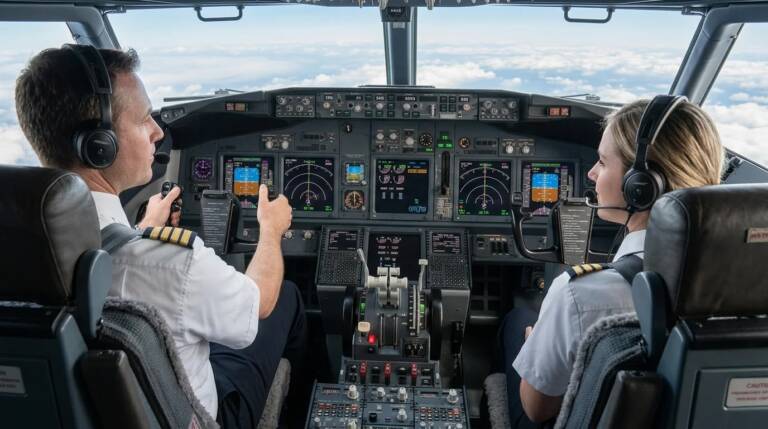
For anyone who has never been inside the cockpit of a commercial airplane, the first impression is usually the same: dozens of screens, switches, and levers that seem impossible to memorize. The reality is different. Every element in the cockpit belongs to a specific system, and once you understand that logic, the cockpit stops being a wall of buttons and becomes an organized set of tools.
In this article we explain how a modern commercial airplane cockpit is organized, what each main system does, and why understanding this logic from the start of your training gives you a real advantage once you move on to more advanced aircraft.
📋 What Is Avionics?
Avionics is the set of electronic systems installed in an aircraft to handle communication, navigation, instrument display, and flight management functions. The term combines the words “aviation” and “electronics,” and it covers everything from the main panel’s screens to autopilot systems and radios.
The Main Sections of the Cockpit
Although the layout varies by manufacturer and aircraft model, most modern cockpits are organized into three main areas: the front panel (where the flight and navigation instruments are located), the center panel (where engine, fuel, and electrical controls sit), and the overhead panel (with switches for secondary systems such as lights, pressurization, and air conditioning). Each area groups related controls so the pilot doesn’t have to search for information in different places while performing the same task.
✈️ What Is the Primary Flight Display (PFD)?
The Primary Flight Display, or PFD, is the main screen in front of the pilot that shows the most critical flight information: aircraft attitude (artificial horizon), airspeed, altitude, heading, and vertical speed. In modern aircraft with glass cockpits, the PFD replaces the individual analog instruments that traditionally occupied that same position.
The 5 Key Systems Every Pilot Must Master
1️⃣ Flight Instruments (PFD)
Less Waiting Time for the Practical Test
The PFD centralizes the so-called “six basic instruments”: attitude indicator, airspeed indicator, altimeter, heading indicator, vertical speed indicator, and turn coordinator. These are the first instruments a student learns to read, because they’re what keeps the aircraft in a safe attitude and flight path at all times.
Mastering PFD interpretation without relying on outside visual references is one of the first skills evaluated in instrument training, and it’s the foundation of any safe flight in low-visibility conditions.
2️⃣ Navigation and Maps (MFD/GPS)
A Verifiable Indicator of Institutional Quality
The Multi-Function Display, or MFD, shows the aircraft’s position on a real-time map, the planned route, weather, nearby traffic, and aircraft systems. It works together with GPS to give the pilot a clear picture of where they are and where they’re headed.
Before GPS and MFD screens, navigation relied almost entirely on manual calculations and visual references. Today, these tools dramatically reduce the pilot’s workload during flight.
3️⃣ Flight Controls (yoke, pedals, and throttle)
The yoke (or side-stick, depending on the aircraft) controls roll and pitch; the pedals control the rudder and the brakes on the ground; and the throttle regulates the power delivered by the engine. These three controls are what physically move the aircraft, and everything else in the cockpit exists to help the pilot decide how to use them.
Even though highly sophisticated autopilot systems exist today, every certified pilot must be able to fly the aircraft manually at any moment, without relying on automation.
4️⃣ Communications and Transponder
The radios let the pilot communicate with air traffic control (ATC), while the transponder transmits the aircraft’s identity and altitude so controllers and other traffic systems can detect it on radar. This system is what connects the aircraft to the rest of the airspace.
Aviation English phraseology is essential here: clear, standardized communication with ATC is just as important to flight safety as any instrument on the panel.
5️⃣ Autopilot and Flight Management (FMS)
The Flight Management System (FMS) allows a full route to be programmed before takeoff and, together with the autopilot, executed with minimal manual input. On large commercial aircraft, this system manages much of the cruise flight, letting the crew focus on monitoring rather than manually operating every control.
The autopilot doesn’t eliminate the need for a pilot: it frees them from repetitive tasks so they can focus their attention on decision-making and on monitoring that everything is working as expected.
✅ Summary: The Cockpit in 5 Systems
1. Flight instruments (PFD) → basic attitude and flight-path information. 2. Navigation (MFD/GPS) → where you are and where you’re headed. 3. Flight controls → physically move the aircraft. 4. Communications → connect the aircraft with ATC. 5. Autopilot (FMS) → manages the flight under the pilot’s supervision.
Analog Cockpit or Glass Cockpit?
Traditional analog cockpits use individual instruments, each with its own mechanism displaying a single piece of data (speed, altitude, attitude, etc.). Glass cockpits replace those individual instruments with integrated digital displays, such as the Garmin G1000 NXi system, which combine all that information into a clearer format with added features like terrain, weather, and real-time traffic.
Most commercial airlines today operate with glass cockpits, so learning to interpret these displays from the start of training significantly shortens the learning curve as a student moves on to larger, more complex aircraft.
ADF Flight School and the Glass Cockpit
At ADF FLIGHT SCHOOL, our Cessna 172 fleet is equipped with the Garmin G1000 NXi system, the same glass cockpit technology you’ll find in modern commercial aircraft. With more than 40 years of history and over 8,000 pilots trained for the world, we prepare our students to operate these systems from their very first lessons, not just in the advanced stages of training.
If you’d like to learn more about our training programs, check out our available programs or talk directly with our team.
Commercial Pilot
Your Commercial Pilot Certificate
Programs
All our FAA courses
Contact Us
Talk to an advisor today
Frequently Asked Questions About the Commercial Airplane Cockpit
❓ Is it hard to learn to use the cockpit instruments?
Not if you learn progressively. Training programs introduce basic instruments first and add more advanced systems as the student gains experience. The key is repetition and consistent practice, not memorizing everything at once.
❓ Do all commercial airplanes have glass cockpits?
The vast majority of modern commercial aircraft do, but older aircraft with analog cockpits are still in operation. That’s why many training programs, including ADF Flight School’s, expose students to both formats.
❓ What happens if a screen fails in a glass cockpit?
Glass cockpit aircraft have redundant systems and backup instruments independent of the main displays. Pilots are specifically trained to operate the aircraft using these backups in the event of an electronic failure.
❓ Do I need to know how to program the autopilot from the start?
No. Initial training focuses on flying the aircraft manually and understanding the basic instruments. Programming the autopilot and the FMS is introduced later, once the student has mastered the fundamentals of flight.
❓ Is a small airplane’s cockpit very different from a large commercial airplane’s?
The principles are the same — flight instruments, navigation, controls, communications, and automation — but the scale and the number of redundant systems increase considerably on large commercial aircraft. Learning the fundamentals well in a training aircraft is what prepares you for that transition.
