
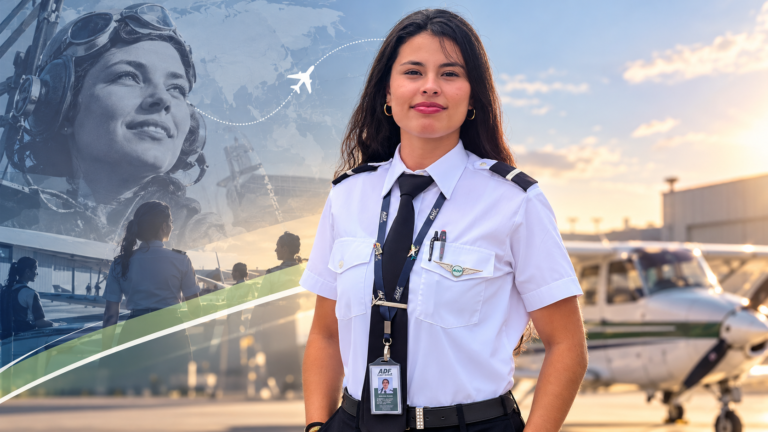
Women have been flying, building, maintaining, and leading in aviation for more than a century. Yet women are still a minority among pilots, which means that every woman who earns her wings, and every young girl who first imagines herself in a cockpit, still makes a real difference for the industry.
In this article we look at why women matter in aviation, who opened the sky for those who followed, what opportunities exist today, and how to take the first step toward a flying career. It’s also a natural follow-up to our recap of ADF Flight School’s participation in American Airlines’ Women in Aviation Day.
📋 What Does “Women in Aviation” Mean?
Women in aviation” refers to the history, the present-day contributions, and the ongoing growth of women across every part of the industry: pilots, flight instructors, mechanics, air traffic controllers, engineers, and airline and airport leaders. The phrase is also used for the efforts, by schools, airlines, and nonprofit organizations, to welcome more women into a field where they remain underrepresented.
Women Have Always Been Part of Aviation
Aviation’s early decades were shaped by women who had to fight for the chance to fly. Their achievements didn’t just prove what was possible; they set the standard and cleared the path for the pilots who came after them. Understanding that history helps explain why representation still matters today.
✈️ Pioneers Who Opened the Sky
Harriet Quimby became the first American woman to earn a pilot’s license in 1911 and later flew solo across the English Channel. Bessie Coleman, in 1921, became the first African American woman to earn a pilot’s license. Amelia Earhart became the first woman to fly solo across the Atlantic in 1932. During World War II, more than 1,000 women served as WASP (Women Airforce Service Pilots), flying military aircraft in support of the war effort. Emily Howell Warner became the first woman pilot for a U.S. scheduled airline in 1973, and Eileen Collins became the first woman to pilot a Space Shuttle in 1995 and the first to command one in 1999.
5 Reasons Women in Aviation Matter
1️⃣ The Industry Needs Talent From Everywhere
Aviation depends on skilled, motivated people. When more women see aviation as a realistic career, the pool of future pilots, mechanics, controllers, and engineers grows, which benefits airlines, flight schools, and the entire industry.
No industry can afford to overlook half of its potential talent, and aviation is no exception.
2️⃣ Role Models Change What Feels Possible
Young people tend to pursue careers they can picture themselves in. Seeing women flying, instructing, and leading in aviation turns an abstract idea into a visible, reachable path. That’s exactly why events like Women in Aviation Day put students face to face with working professionals.
Representation doesn’t guarantee anyone’s success, but it removes one of the biggest early barriers: not being able to imagine yourself doing the job.
3️⃣ Different Perspectives Strengthen Teams
Aviation safety relies on crews communicating openly, sharing information, and speaking up when something doesn’t look right. Teams made up of people with different backgrounds and viewpoints can bring more perspectives to problem-solving, which fits well with the teamwork principles taught in Crew Resource Management.
Strong aviation teams are built on trust and communication, and both grow when everyone feels they belong in the room.
4️⃣ Aviation Careers Go Beyond the Cockpit
Women contribute at every level of the industry, from flight instruction and airline operations to maintenance hangars, air traffic control towers, engineering teams, and executive offices. Showing the full range of roles helps more people find the career that truly fits their strengths.
Whether someone dreams of flying or of keeping aircraft flying safely, there’s a place for them in aviation.
5️⃣ The Path Is Open and There's Support Along the Way
FAA certification standards are the same for every pilot, and a growing network of organizations, including Women in Aviation International and The Ninety-Nines, offers mentorship, community, and in many cases scholarship opportunities for women entering the field.
Scholarship availability, eligibility rules, and amounts vary by organization and change over time, so always confirm details directly with each organization.
✅ Summary: Why Women in Aviation Matter
Talent → a broader pool strengthens the whole industry.
Role models → visible examples make careers feel reachable.
Perspectives → varied viewpoints support strong teamwork.
Careers beyond the cockpit → there are many ways to contribute.
Support → the standards are the same for everyone, and communities are ready to help.
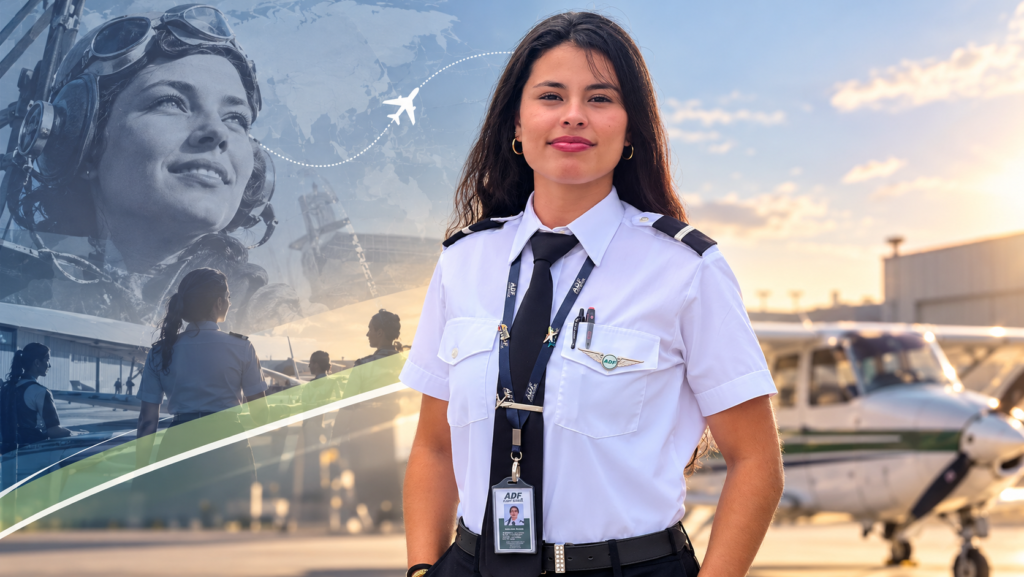
How to Get Started on Your Own Flying Career
If you’re thinking about flight training, the first steps are simpler than they might seem. Start by learning how the path works, from private pilot through the certificates and ratings that lead to a professional career, and by reviewing the FAA’s requirements, including the medical certificate, early so nothing surprises you later. Then talk with a flight school about what a first lesson looks like, what training costs and timelines look like for your goals, and what support is available. Connecting with a community such as Women in Aviation International or The Ninety-Nines can also give you mentors and peers who’ve walked the same road.
Women at ADF Flight School
At ADF FLIGHT SCHOOL, located at Miami Executive Airport, women are part of the school at every level. Our CEO, Alex Derly Farkas, is a pilot herself, and our community includes female flight instructors and female students working toward their certificates. With more than 42 years of history and over 8,000 pilots trained for the world, we’re proud to help every student, whatever their background, reach their goals in the air. You can also read how we took part in American Airlines’ Women in Aviation Day, or learn about the full path in our guide on how to become an airline pilot.
To explore training options, check out our available programs or talk directly with our team.
Commercial Pilot
Your Commercial Pilot Certificate
Programs
All our FAA courses
Contact Us
Talk to an advisor today
Frequently Asked Questions About Women in Aviation
❓ Are there fewer women pilots than men?
Yes, women remain a minority among pilots. For current, verified figures, we recommend checking data published by the FAA and by Women in Aviation International rather than relying on numbers quoted in articles, since they change over time.
❓ Are the requirements to become a pilot different for women?
No. FAA certification standards, including knowledge tests, flight training requirements, and practical tests, apply equally to every applicant.
❓ Are there scholarships for women in aviation?
Several organizations, including Women in Aviation International, offer scholarships or support programs. Eligibility, amounts, and deadlines vary and change, so check directly with each organization for current details.
❓ Do I need any aviation experience to start flight training?
No. Flight training is designed for beginners, and most students start with no prior experience. A flight school can walk you through what to expect from your very first lesson.
❓ Can girls start learning to fly while they’re still teenagers?
Under FAA rules, you must be at least 16 to fly solo in an airplane and 17 to earn a private pilot certificate. Many students begin lessons before those ages, but always confirm current requirements with the FAA or a flight school.